
SUL4R-PLUS® Sustainability: Carbon Footprint and Life Cycle Analysis
Travis Banet, PhD (Integrated Plant and Soil Sciences)
SUL4R-PLUS Manager of Research and Development
In 2025, SUL4R-PLUS partnered with Tunley Environmental to answer two questions:
- What is the carbon footprint of SUL4R-PLUS?
- What overall effect does using SUL4R-PLUS in the field have on greenhouse gas emissions?
What is a carbon footprint?
Every process requires some kind of energy source. Gas-powered vehicles get their energy from burning gasoline. Electric vehicles (most likely) get their energy from burning coal at a power plant, which transforms the combusted coal into electricity that is stored in the vehicle’s battery. Processes that consume energy commonly create greenhouse gases as a byproduct of the chemical reactions that power each process.
A carbon footprint describes the amount of greenhouse gases that are created when fuel and energy are used to power a process.
What makes up the carbon footprint of SUL4R-PLUS?
The SUL4R-PLUS carbon footprint can be divided into three phases:

- Raw material extraction includes all the greenhouse gases created to harvest ingredients from their sources.
- Raw material acquisition includes all the greenhouse gases created during the transport of the ingredients from their sources to the point of production.
- Manufacturing includes all greenhouse gases that are created during production.
What is the SUL4R-PLUS carbon footprint?
About 63% of the SUL4R-PLUS carbon footprint comes from raw material extraction. Raw material extraction for SUL4R-PLUS can be broken down into three items:
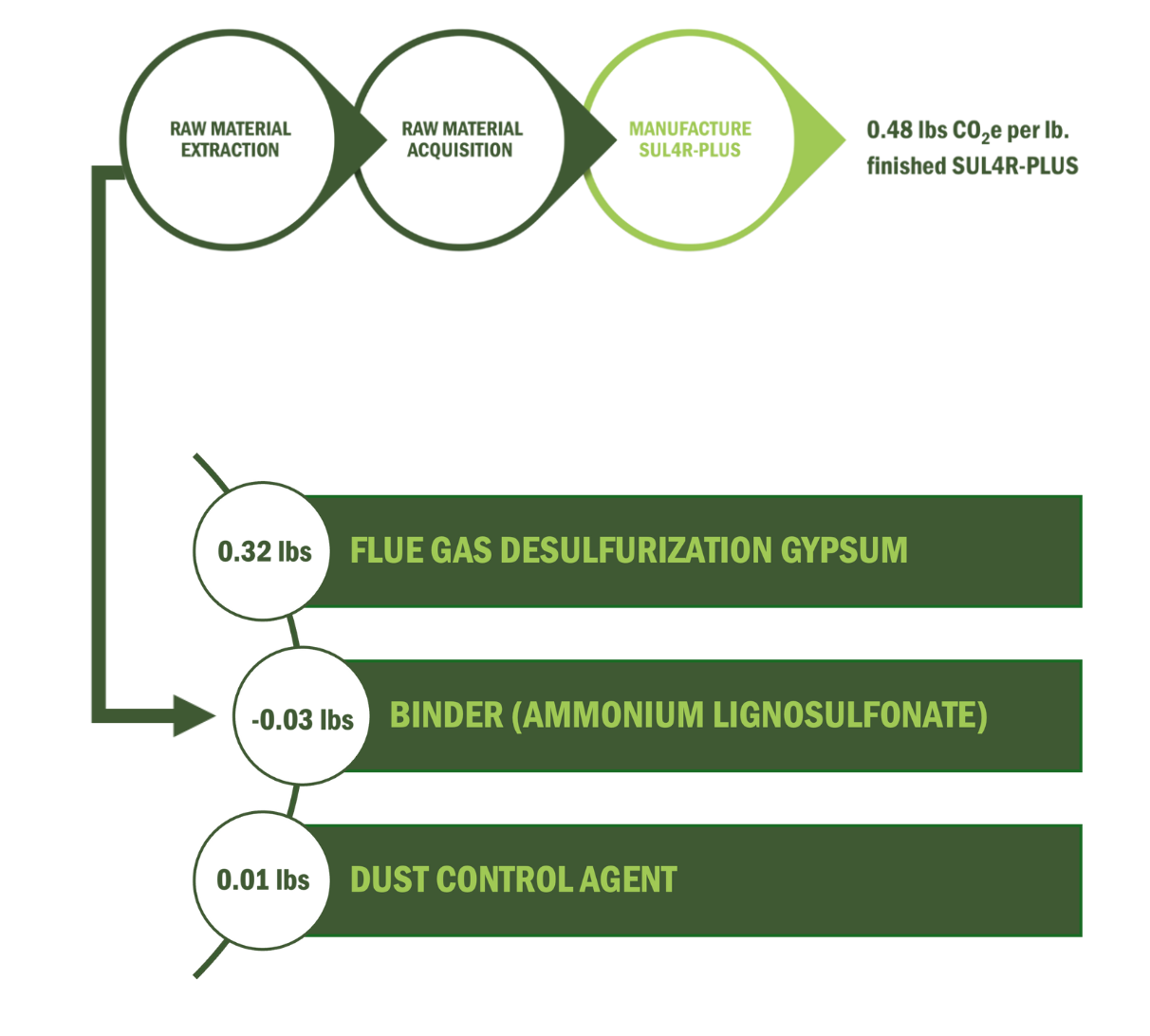
Creating Flue Gas Desulfurization (FGD) gypsum, a main ingredient in SUL4R-PLUS, is energy intensive and accounts for more than half of the SUL4R-PLUS carbon footprint.
However, even if SUL4R-PLUS was not on the market, FGD gypsum would still be produced and contribute to CO2 emissions. FGD gypsum is a waste product created as coal-fired power plants scrub sulfur-based gases from smokestacks. Per federal regulations, these sulfur-based gases must be scrubbed out of smokestack exhausts to prevent harmful acid rain.
SUL4R-PLUS repurposes the FGD gypsum waste into a valuable product that can enhance plant growth and performance. Check out our research from the field to learn more about the impact that SUL4R-PLUS has on crop yields.
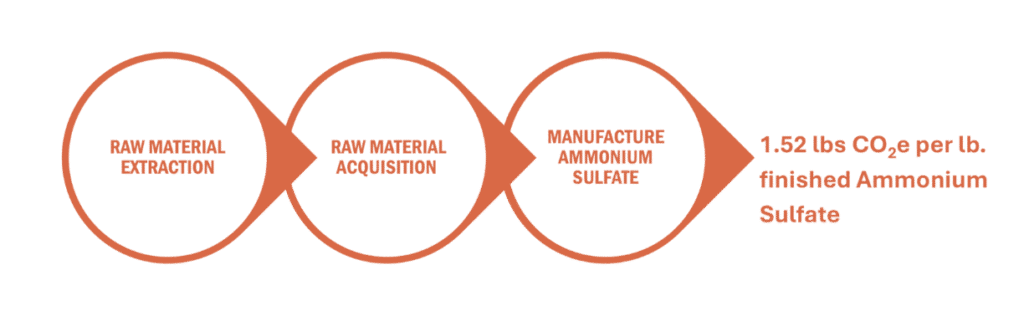
The SUL4R-PLUS carbon footprint is also 68% less than ammonium sulfate, a commodity fertilizer also used to supply plant-available sulfur.
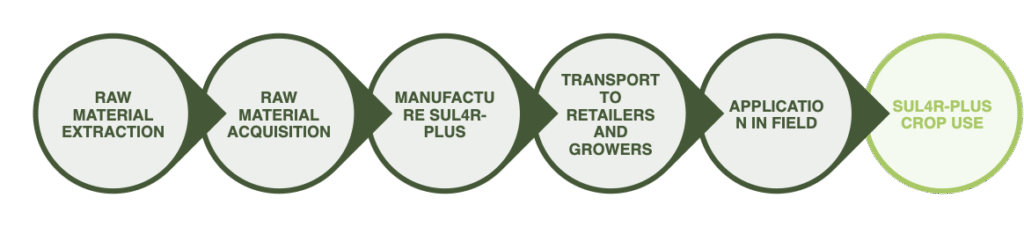
What is the complete life cycle of SUL4R-PLUS?
After production, SUL4R-PLUS is transported to retailers and growers, applied in the field, and then taken up by plants.
Unlike previous steps in the product’s life cycle, using SUL4R-PLUS results in negative emissions. Negative emissions indicate that CO2 is being removed from the atmosphere rather than added to the atmosphere.
Net CO2 emissions = -82.6 lbs Co2e over one acre treated with 100 lbs of SUL4R-PLUS
Our Mill Creek Production Facility makes about 60,000 tons of SUL4R-PLUS each year. At 100 lbs SUL4R-PLUS per acre, that’s enough to treat 1.2 million acres of cropland, and remove approximately 50,000 tons more CO2 than untreated croplands.
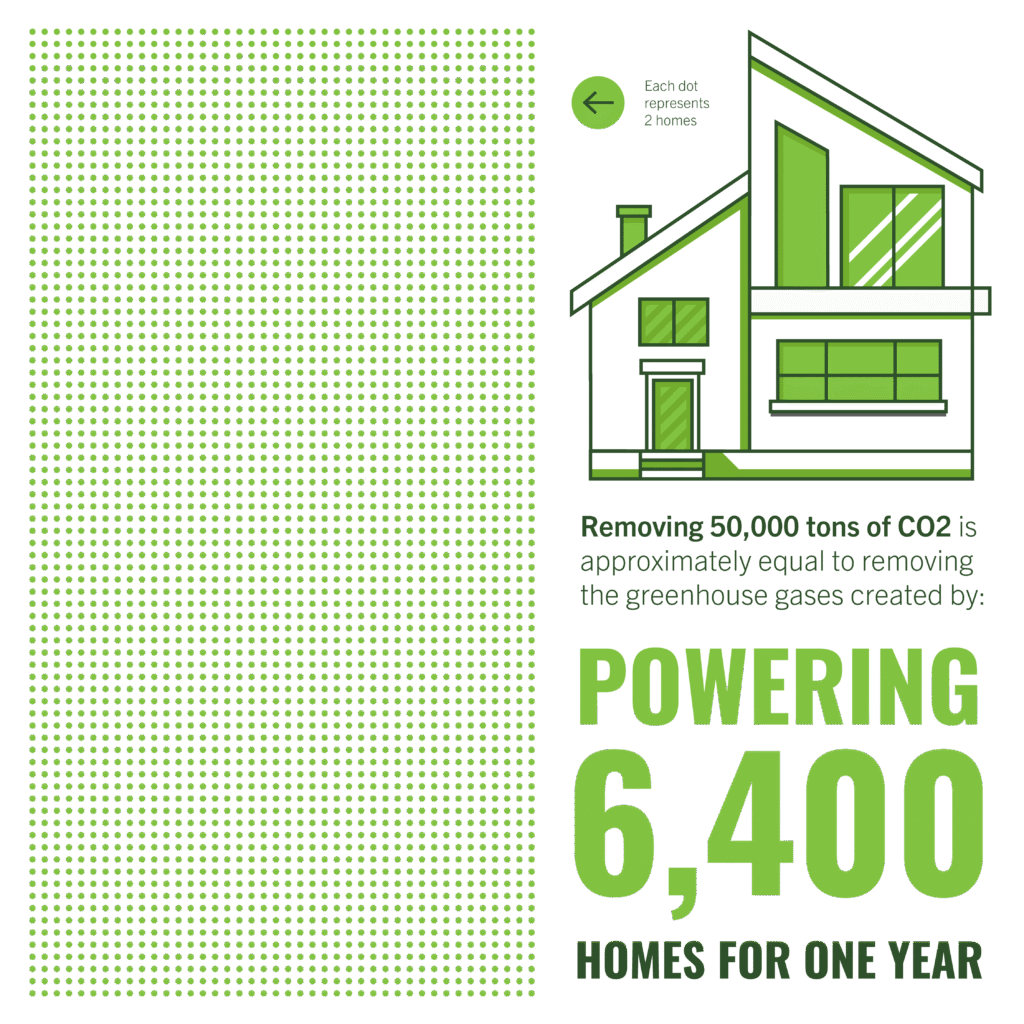
For comparison, removing 50,000 tons of CO2 is approximately equal to removing the greenhouse gases created by:
- Driving 11,000 powered passenger vehicles for one year
- Consuming 5.4 million gallons of gasoline
- Burning 53 million pounds of coal
- Powering 6,400 homes for one year
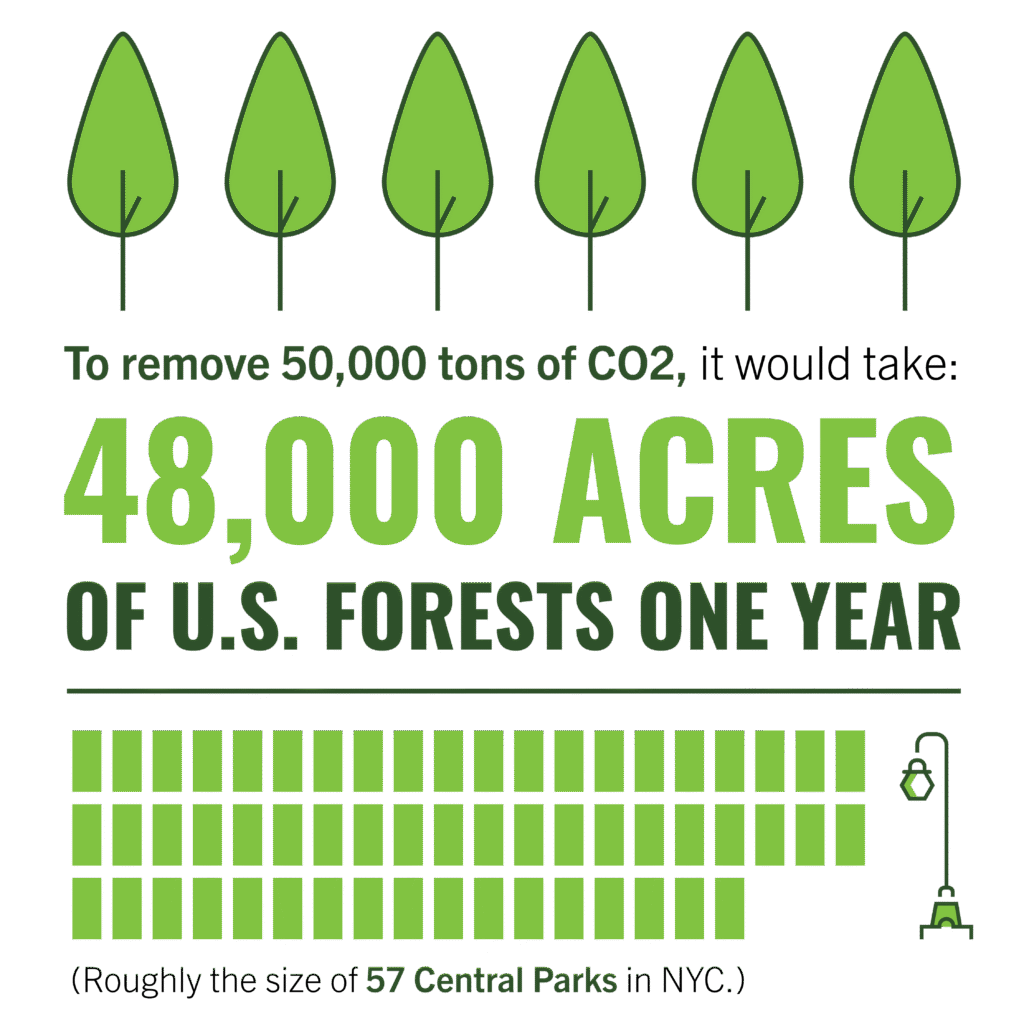
To remove 50,000 tons of CO2, it would take:
- 795,000 tree seedlings 10 years
- 48,000 acres of U.S. forests one year
How does SUL4R-PLUS enhance CO2 removal?
Field trial data from 2016 to present has shown that SUL4R-PLUS can increase crop growth compared to untreated fields. More crop biomass in the field means that more photosynthesis is happening and drawing down increased levels of CO2 from the atmosphere to grow crop stems higher, larger leaves, and produce more grain, seed and fruits (figure for animation concept below).
For more details on the Carbon Footprint and Life Cycle analysis from Tunley Environmental, please see the full report.
Note: CO2e stands for “CO2 equivalents.” Not all greenhouse gases are equal, and some retain more heat than CO2. These gases have been accounted for and are standardized as CO2 equivalents, or CO2e. Units in this blog post have been converted into lbs of CO2e per lb of SUL4R-PLUS, whereas the full report displays the results in kg of CO2e per lb of SUL4R-PLUS. Approximations of CO2 emissions created by burning fossil fuels, powering homes, removed by tress, etc., were calculated using the U.S. EPA Greenhouse Gas Equivalencies Calculator.
Get expert insights, company news & trial data.
Here’s a few similar resources we think you may find interesting.

Calcium Clarified: Corn
Calcium is an important nutrient for proper corn plant nutrition. Even though it is a secondary nutrient, calcium is critical for optimizing plant strength, ear and kernel development and plays a key role in numerous physiological processes throughout the plant.
Read More
Employee Spotlight: Noah Binkley
Noah Binkley, a Sales Manager with SUL4R-PLUS, has been an integral part of the team since 2021. With over 10 years of experience in the agriculture and fertilizer business, Noah brings invaluable expertise to our mission of helping farmers achieve higher yields.
Read More
Bulk Up Your Winter Wheat: Increase Protein with SUL4R-PLUS
SUL4R-PLUS can help North American wheat producers this winter. Thanks to season long plant-available nutrients, our fertilizer not only improves yield, it also improves the quality and protein content of winter wheat. Just take a look at this trial from Meyer Farms in Washington County, IL.
Read More